
Software is solved. Now what?
Earlier this year I made kittenpm.com, a silly product management sim game. I had planned to write a “how I built kittenpm with AI” post, full of caustic wisdom and first-hand learnings …
But I’m not sure it would help anyone now. Writing software is largely solved. So instead, here’s how it happened - and what might come next.
Changing ways of working
November 2025. Documentation and ideation with ChatGPT & Claude. I use AI as a sparring partner, but the thought process is largely my own.
December 2025. First MVP built. Running Claude in a terminal feels cool. Claude reports everything is amazing, but the result is underwhelming. Disconnect between LLM perception and reality.
January 2026. I change tack and adopt a more classic software development pattern, the product improves, but progress is slow. LLMs are good for simple clones, but cannot hold the complexity of large systems, certainly not novel ones. It feels like a house of cards. I attempt adversarial code review by cutting and pasting code between Claude & ChatGPT.
February 2026. Unit tests and compartmentalisation improve quality, but UI is still prone to hallucination and requires human review. I integrate with Playwright to give Claude eyes, this improves somewhat - but doing anything with custom graphics still feels like working with sludge.
March 2026. Anthropic launch their Opus model - a step-change in performance. Less scaffolding and herding is required to complete any given task. It begins to feel like the promise.
April-May 2026. Performance degradation and outages as Anthropic struggle to keep up with demand. The Claude desktop app changes daily. I decide to enjoy the spring weather.
June 2026. Anthropic launch Fable - I squeeze in two days of lightning progress, before US Export Controls slam the shutters closed. I go to the beach.
July 2026. Anthropic launch Fable (again). Another step-change acceleration in performance. Even less scaffolding is required, and conversations move beyond basics and focus on intent. Claude spins-up teams of agents to execute my whim, and in short-time refactors kittenpm, creating a harness to model & balance gameplay. I launch.
August 2026. The site gets some international traffic. I ask Claude to make a custom-sprite generation tool and graphics finally seem to be solved. Making a game feels fun & productive.
September 2026. Claude can do more and more work unsupervised, I create an overnight loop for Claude to look at the stats, and iterate the product forward. It creates a proposal to make the game mobile ready, but I find myself losing interest.
Moving boundaries
In October, Google launched Playground, a new tool where anyone can “create custom games in minutes”. The next day, I mentioned it to someone who builds training games for a living.
“Oh, it’ll be slop” he said.
And it probably will be. But for how long?
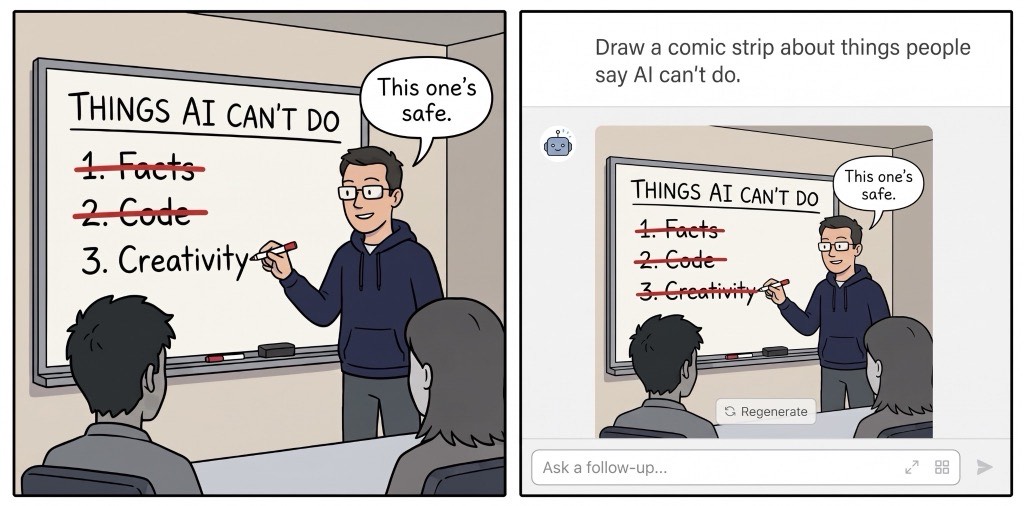
We’ve consistently underestimated AI. In the beginning, LLMs were a fun gimmick - they held a conversation, but could not be relied on for serious work.
- It hallucinates, it can’t be trusted - until it learned to look things up and cite them.
- It can’t see the result, so it can’t do design - until it got a browser.
- It can’t write production code without a human reviewing it - until a second model did the review.
- It can’t do maths or logic - until it solved a Millennium prize problem.
- It can’t do creativity, only clone existing work …
Every one of these objections was true until it wasn’t. We’ve consistently excused the limits of what AI can do, and what only humans can do. And the boundary has consistently moved.
And the pace is only accelerating.
What’s next?
Writing software is largely solved, and what’s left will probably follow. When there is no barrier to creating software, software alone has no value, and the future of software is probably open-source.
Every major technological shift removes a constraint and changes what is scarce. And every time a constraint disappears the value moves to whatever becomes scarce next*.
Currently this is regulated systems, infrastructure and people.
Regulated systems because they have hard requirements & increased complexity, infrastructure because of the physical constraints and CAPEX. And people, because (to borrow from IDEO) a complex system is anything with people in it.
Regulation and infrastructure will likely loosen with time. But people will always be complex: Will customers want to pay you for your new product? Will colleagues adopt to the new way of working?
* See Reshuffle: Choudary, or even The Goal: Goldratt & Cox. Also more thinking on AI moats here.